TL;DR
Fix what can hurt a client today, in this order: secret keys in the browser, one client reaching another’s data, fields a client can set that they should not, then whether you can restore from a backup. Each step has a check you can run yourself. Leave the rewrite, the refactor and the code style for later. If you hire someone for a code audit, ask for the proof of each step, not a score.
You built it with Lovable, Bolt, Cursor or similar. It works, people pay for it, and now a client’s security questionnaire or a post on Reddit has made you wonder what is under it. That worry is reasonable: in one study of 200 deployed apps, 182 had at least one vulnerability, and broken access control led the list. The more useful question is what to do on Monday.
This is the order I work in when I take over an app like this. It comes from those apps and from tests I reran on a local stack; the numbers below are from my own runs, on made-up data.
Why not start with a rewrite?
Because a rewrite fixes nothing this week, and your clients’ data is exposed this week. It also throws away the part that already works: the behaviour your clients pay for. I decide keep, repair or rewrite for each part of the app after the audit, and most parts stay.
Style, folder structure, test coverage and old dependencies also go after the list below. They matter. They just do not decide whether a client’s data leaks tonight.
The order
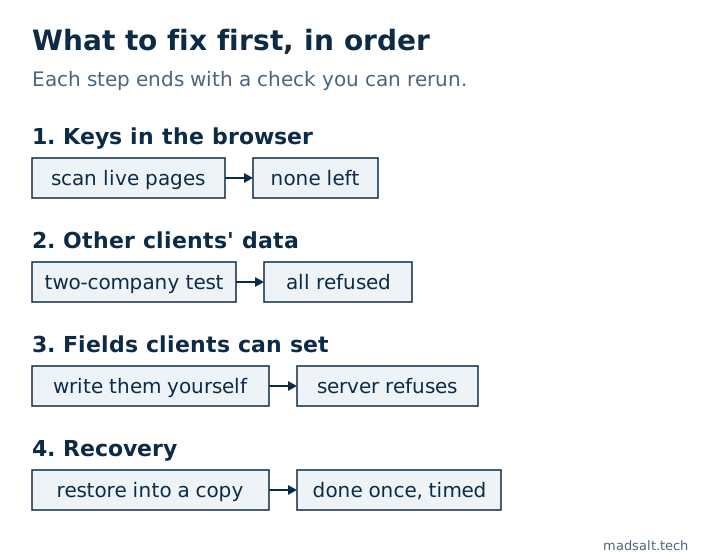
| Order | What | The check | Done when |
|---|---|---|---|
| 1 | Secret keys in the browser | Scan the live pages and built JavaScript | No secret key in any public file |
| 2 | One client reaching another | Two users in two companies attack each other | Every cross-company path is refused |
| 3 | Fields clients should not set | Try writing role, status and price yourself | The server refuses or overwrites them |
| 4 | Recovery | Restore a backup into a copy | You did it once and timed it |
1. Are secret keys in the browser?
Start here because it takes minutes and a leaked secret key undoes everything else. A Supabase secret or service_role key skips every access rule, and in my test of a leaked key it read all rows under owner-only policies and listed every user.
The free secret scanner reads one public page and the scripts it links. Run it on your main public pages. It cannot see behind a login, so also search the repo and your hosting settings: anything prefixed NEXT_PUBLIC_ or VITE_ goes to the browser.
Found one? Replace it first, then look for what changed while it was out. Public keys such as a Supabase publishable key or a Firebase apiKey are meant to be there, and are safe only if the rules behind them hold, which is step 2.
2. Can one client reach another’s data?
This is the step with paying clients on the line, and the one where a quick look misleads. I built a schema with mistakes I see in real apps and sent 14 requests at a second company. The four read checks most people try came back clean. Six other paths leaked, through a child table, a view, a function, the members list, and two kinds of write. How to run it is in the multi-tenant isolation test.
If you are on Supabase, run the free Supabase security check first. It lists what the catalog can show, such as tables with RLS off and policies that allow every row. Then run the free tenant isolation test with one user from each of two companies, and it shows which rows both can read. On Firebase, these rule mistakes are where I look, and files have their own.
Clicking through your app as a second user will not find these. Your screens only ask for what they are built to ask for. Send the requests directly.
3. What can a client set that they shouldn’t?
Generated code often trusts what the browser sends. Open DevTools, copy a save request and change a field:
- Your role, on your own profile
- The status of your own record, such as
approvedorpaid - A price, a plan or a credit balance
- The owner or company id on a record
In a client’s app I reviewed, the browser sent status: 'approved' itself and skipped moderation. A policy can say who may write a row, but it is a poor place to compute values. Anything money or permission depends on should be set by the server or a database trigger. The Lovable checklist has more of these, and the same bypass tends to sit in every other path that writes the field, so list them all before fixing the first.
4. Could you recover from a bad day?
Someone with a bug or a stolen login deletes a table. Do you have a backup, and has anyone restored it? A backup you have never restored is a hope. Restore one into a separate project, check the data, and write down how long it took. What Supabase backups cover depends on your plan, so read that before relying on them.
What can wait?
- Rewrites and framework moves. Decide after the audit, part by part.
- Code style and duplication. Slower work later, not a client risk today.
- Full test coverage. Write the two-company test first; it covers the risk that can end the business.
- Scanner scores. Useful as a list of leads. A clean score does not answer step 2 or 3.
Rate limits on sign-in and paid endpoints come right after the four steps. I would not put them ahead of a leak.
Do you need to tell your clients?
If a test finds a hole with no sign it was used, fix it and keep a record of what you found and when. If personal data was actually exposed, it may be a reportable breach: under GDPR Article 33 a controller generally has 72 hours from becoming aware, and your contracts may add their own terms. Ask a lawyer as soon as you suspect that. It is not a call to make alone.
What should you ask someone you hire?
If you pay for a code audit or a cleanup, these questions separate proof from opinion:
- Will you test with two real accounts in two companies, and show me each path and result?
- Will you check the live database and live pages, not only the repo?
- Which findings do I fix this week, and which can wait, and why?
- What do I keep, repair or rewrite?
- How can I rerun your checks after you are gone?
A long PDF with a score and no reproducible requests leaves you where you started.
Limits. This is my order, from apps on Supabase and similar backends, and it is not a compliance programme. Apps with health or payment data have extra duties that come on top. The test numbers come from a small schema I broke on purpose, so they show what a quick check can miss, not how common each mistake is. The legal note is general information, not advice.
If a buyer asks for a penetration test report, what one costs in 2026 is in a separate article.
Not sure who to hire for this? Hire a developer to fix a Lovable app compares five kinds of help and the prices they publish.
My similar case
A company I built for was paying thousands of dollars a month for an enterprise document product. Its own platform now costs hundreds a month, with roles for documents, forms, reports and a client portal, and only the features the team uses. See the construction document platform case.
Have paying clients on a vibe-coded app? Write to me and we’ll work out what to fix before it costs you a client.
Paying clients on a vibe-coded app?
Tell me what you have now and what you need. I'll reply with the option I'd pick.
Write to me