TL;DR
An AI automation specialist connects an AI model to your tools and documents so a routine job runs without a person typing. You can get one four ways. Published seller prices run from about $700 a month for a 10-hour package, through $2,500 a month and up for an agency retainer, to about $13,300 a month for a US employee once benefits are counted. Pick the one that matches how often your work changes. Before you commit, give any candidate a paid test task on a real example, and walk away from anyone who promises results without asking to see your data.
I’m Denys, a forward deployed engineer in Porto, so I am one of the options on this page. Where another option fits you better, I say so.
What does an AI automation specialist do?
They take one repeated job and make a system do it: read incoming emails or invoices, look up the customer in the CRM, draft a reply, update a record, and ask a person only when the system is unsure. The tools are usually a workflow builder such as n8n or Power Automate, a model API, and your own systems.
I counted what companies actually ask for. In 258 AI job posts from 204 companies (LinkedIn, 7 days to 6 November 2026, staffing and consulting firms removed), the most common requests were:
| Asked for in the post | Share of posts |
|---|---|
| Connect a model to company documents (RAG) | 37% |
| n8n | 29% |
| Copilot Studio or Power Platform | 22% |
| CRM work (any CRM) | 19% |
| Power Automate | 18% |
| Documents, invoices or OCR | 8% |
| Contract, freelance or fractional | 5% |
A post counts once per theme, and I matched the themes with a text search that I did not check by hand. Read it as a rough picture. The point for you: the job is mostly plumbing between a model and the systems you already have, not research. And only 5% of those companies wrote “contract” or “freelance” in the post. Most are trying to hire an employee.
How much does an AI automation specialist make?
If you hire one as an employee, this is the salary side. Each figure below is stated on the page named, read on 12 November 2026. Two of them come from salary sites by way of a guide, not from the site itself:
- ZipRecruiter, September 2026, as quoted by a staffing seller (Pareto Talent): an AI automation specialist in the US averages $76,465 a year. An automation agency’s guide (Layer3 Labs) gives the same number for the title “Workflow Automation Specialist”, with a middle range of $57,000 to $98,500, so treat the title as approximate.
- Glassdoor, as quoted by that agency guide (Layer3 Labs, 2 September 2026): a remote AI automation specialist in the US averages about $127,500, typically $115,000 to $140,000.
- Salary.com, 1 July 2026, read on the Salary.com page: the broader title “Automation Specialist” averages $104,366.
The spread is wide because the job titles are new and the data is thin. A US seller guide puts an in-house AI engineer at $160,000 to $215,000 a year fully loaded, which means with benefits and overhead, about $13,300 a month at the low end. Base salary is not what you pay.
How much does it cost to hire an AI expert, and how much do people charge for AI automation?
Sellers publish these prices. I opened each seller’s page on 12 November 2026 and could not check any of them against real invoices. I name the sellers in plain text and do not link them.
| Option | Published price | Good for | Watch for |
|---|---|---|---|
| Freelancer, hourly | $75 to $150 an hour in one rate guide (AY Automate), $150 to $250 in another (Lets Viz), $40 to $100 on marketplaces in a third (HiresLink) | One defined workflow, a proof of concept | Rates differ a lot by source; one person is also one point of failure |
| Hours package | $700 a month for 10 hours, $1,200 for 20, $2,000 for 40 (HiresLink, nearshore) | Steady small tasks | You are limited by the hours in the package |
| Agency | $3,000 to $15,000 for a project, $2,500 to $8,000 a month retainer (Lets Viz, US) | Several processes at once, compliance paperwork | Who writes the code, and whether the person you meet is that person |
| Employee | $160,000 to $215,000 a year fully loaded for a US AI engineer, 3 to 6 months to hire and onboard (Lets Viz) | A permanent seat and more than a year of work | Time to hire: see below |
| Me, on a monthly plan | Flat fee, see pricing | Shipping weekly with one person who learns it | One person, not a team |
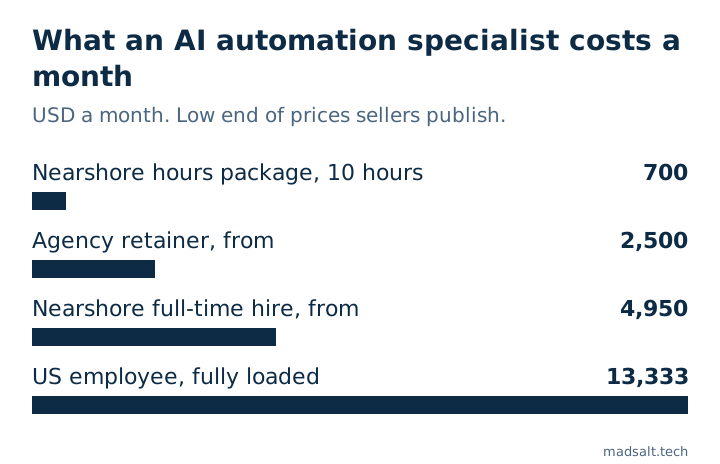
The chart shows the low end of each monthly range, and the employee row is $160,000 divided by 12, my arithmetic. A nearshore full-time hire is $4,950 a month and up, per HiresLink. These are sellers’ own blogs and rate cards, so they have an interest in the numbers.
If you want to compare against a normal developer hire, alternatives to hiring a full-time developer and developer on a monthly retainer cover the same ground for general software work.
Freelancer, agency or employee?
- Under a dozen automations, each defined in a sentence: a freelancer on a fixed price. Ask what you hold when it ends.
- Several processes at once with contracts and compliance paperwork: an agency.
- A permanent function with work for more than a year: an employee. Finding one takes time. Randstad Digital reported that the time to hire AI managers more than doubled to 53 days in the first quarter of 2026, from 25 days four years earlier.
- Work that keeps changing, fixes and new ideas arriving every week: one person who stays, on a retainer or a monthly plan. That is what I do. If your work is a single build and then nothing, I am the wrong choice.
For the wider comparison with who writes the code in each model, see forward deployed engineer vs agency vs freelancer and hire a forward deployed engineer.
What should the first four weeks look like?
This is what I do with a new client. Ask any candidate for their own version and compare.
- Week 1: one process, one number. We pick the single job to start with and write down how many hours or cases it takes a month today. I also check access: I ask for the least access that lets me work, in accounts you can remove.
- Week 2: a thin version on real examples. A first workflow that handles the easy 80% of cases and sends the rest to a person. You see it running on your own data, not on a demo.
- Week 3: failure cases. We find what breaks: odd formats, missing fields, a wrong answer. Each gets either a fix or a rule that sends it to a person.
- Week 4: handover of the running thing. It runs without me watching it, an alert fires when it stops, and you hold the documentation, the deploy steps and the accounts in your name.
A candidate who cannot tell you something like this, or who starts with a platform choice before asking what the job is, has not done it before.
What should a paid test task look like?
Pay for a small test. A paid test task of a few hours on one real example tells you more than any interview.
- Pick one real, low-risk example from your own work, such as ten incoming documents or emails. Remove anything private you cannot share.
- Define the pass mark before they start. For example: “At least 9 of 10 correct, and the rest flagged for a person, never silently wrong.”
- Ask for three things back: the working result, a list of the cases it got wrong, and what it would cost to run per month.
- Watch how they ask questions. A good candidate asks about the volume, who checks the output and what a mistake costs you.
What interview questions should you ask an AI automation specialist?
- What was the last automation you built that stopped working, and how did you find out?
- What happens in your design when the AI is unsure?
- Who pays for the model calls, and how would you cap the monthly bill?
- What do I hold if we stop working together tomorrow?
- Which part of my job would you not automate, and why?
I wrote about what a running agent costs in how much an AI agent costs per month; a candidate should be able to talk about the same meters.
If you are not sure how to describe the job, my free AI job description generator turns a rough description into a brief you can post or send to a candidate.
What are the red flags?
- They promise a result before seeing your data. Results depend on the documents and systems, which they have not seen.
- No answer for “what happens when it is wrong”. Every system is wrong sometimes. The design should say what then.
- The code and accounts sit with them. You should own the repository and the accounts from the first commit.
- Only a demo, never a running example. Ask for something that has run for at least a month.
- Tool first, problem second. “We will use X” in the first call is a sign they sell a tool.
- No cost-to-run number. Models, servers and paid APIs cost money every month, and a specialist who has run something knows roughly how much.
- Vague about who does the work. The person on the call and the person doing the work should be the same.
If you already have a quote, I will read it for free and tell you what it leaves out: second opinion on a developer’s quote.
How do the first weeks run with me?
I join your Slack or Telegram, take tasks from you and deploy what I build. A task is one scoped deliverable, such as an integration or a workflow. The code is yours from the first commit. The plan runs month to month, you can pause or cancel any time, and the first week has a full refund if you are not satisfied. Plans and prices are in the pricing section.
What I am not: a team. A project that needs a designer, a mobile developer and a tester working in parallel belongs with an agency.
My similar case
For a client I built a WhatsApp and Telegram chatbot. It answers routine questions from the company’s own documents, scores each lead as cold, warm or hot, and hands hot or unsure chats to a person from a shared inbox. The conversation runs on a flow the client’s team can edit, so the people who know the business set the rules. The build is in the WhatsApp and Telegram chatbot case.
Want to know what your first automation would take? Write to me with the job and we’ll work out the best option for you.
Tell me what to automate
Describe the repeated job and where it lives today. I'll reply with the option I'd pick, even if that is not me.
Write to meSources
- Seller price pages, opened 12 November 2026, named without links because they sell competing services: Lets Viz, “How to hire an AI automation consultant”, 20 August 2026 (freelancer $150 to $250 an hour; agency project and retainer; employee $160,000 to $215,000 fully loaded; 3 to 6 months to hire and onboard). AY Automate, AI consultant hourly rate guide, 6 August 2026 (freelancer $75 to $150 an hour). HiresLink, cost to hire AI automation consultants, 30 June 2026 (marketplace $40 to $100 an hour; hours packages; full-time nearshore hire from $4,950 a month).
- Salary figures: Pareto Talent guide, 7 October 2026, quoting ZipRecruiter of September 2026 (not opened at ZipRecruiter); Layer3 Labs guide, 2 September 2026, quoting Glassdoor and ZipRecruiter (not opened at those sites); Salary.com, “Automation Specialist” page, 1 July 2026 (opened directly).
- Randstad Digital report, as reported by the Economic Times, 23 June 2026: time to hire AI managers 53 days in Q1 2026, up from 25 days four years earlier.
- My own count of AI job posts: 258 posts from 204 companies, LinkedIn, 7 days to 6 November 2026.