TL;DR
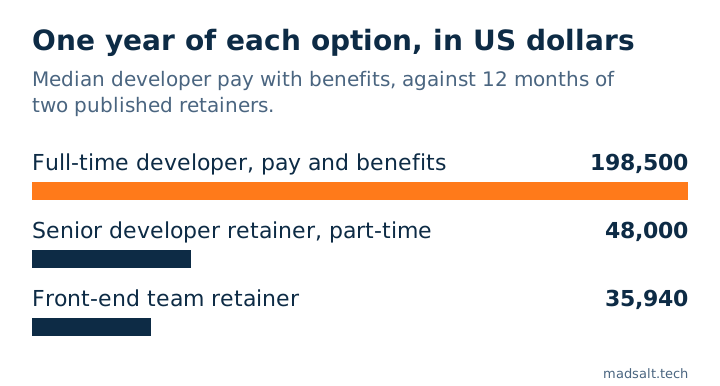
A full-time developer in the US costs about $198,500 a year once benefits are counted, and takes months to hire. If you do not have a full week of development work every week, you have five alternatives: a freelancer per job, a part-time developer, an agency retainer, a development subscription, or an app builder with an engineer on call. Pick by how steady your work is, not by the hourly rate.
I’m Denys, a forward deployed engineer in Porto. I sell one of the five options below, a monthly subscription, so read my view with that in mind. I name the cases where hiring or a freelancer beats what I sell.
What does a full-time developer really cost?
About $198,500 a year in the United States, by my arithmetic from two official numbers.
The Bureau of Labor Statistics puts the median wage of a software developer at $135,980 a year (May 2025). Wages are not the whole cost. In the same bureau’s employer cost release for June 2026, wages make up 68.5% of what a full-time private-industry employee costs, and benefits the other 31.5%. Divide $135,980 by 0.685 and you get about $198,500 a year, or $16,500 a month. The benefit share is an average over all full-time private jobs, not developers alone, so treat the result as an estimate.
Time is the second cost. Upwork’s research gives a median of 35 days to fill a full-time role, and Upwork sells the faster option, so weigh that. Add notice and ramp-up and a hire starts contributing 3 to 7 months after you open the role, by my sum of the ranges in how long hiring an engineer takes.
Do you have enough work for a full-time developer?
Write the list before you decide. Put down every change you would ask a developer for in the next three months, with a rough size next to each: an hour, a day, a week.
If the list fills five days a week, every week, hire. If it comes to a few days a month, a salary pays mostly for waiting. One UK software firm that does this exercise with clients says most small businesses find 15 to 60 days of work a year. That is their experience with their clients, not a survey, but it matches what I see: the list is shorter than the owner expected.
What are the alternatives?
| Option | You pay | Published prices I read on 10 November 2026 | Right when | Breaks when |
|---|---|---|---|---|
| Freelancer per job | Per hour or per job | $50 to $150 an hour on open marketplaces, in one roundup of 2026 rates | One task you can describe in a paragraph | The work never ends and the context leaves each time |
| Part-time or fractional developer | Days a week or hours a month | No standard price list; quoted per person | Steady work that fills one or two days a week | You need them on a day they sell to someone else |
| Agency retainer | A block of hours each month | From $2,995 a month for front-end work; from $4,000 a month part-time | Predictable work that needs several skills | Quiet months: you pay for hours you do not use |
| Development subscription | A flat fee for a queue of tasks | A UK firm lists £2,500 and £4,000 a month on a 12-month term | A product that changes every week | A build that needs design, mobile and QA at once |
| App builder plus an engineer on call | A tool fee plus occasional help | Tool plans vary; the engineer is priced as a freelancer | Simple internal tools and first versions | Real users, payments or personal data arrive |
Three things in that table decide most cases.
How steady the work is. Hours bought in advance suit a steady flow. Lumpy work suits paying per job or a queue you can pause.
Who holds the context. Every new freelancer learns your system at your expense. A person who stays, on any contract, stops charging you for that.
Who talks to you. In a team retainer the person you brief is often not the person who writes the code. Who stands between you and the code compares the four setups.
When is hiring still the right answer?
- Software is what you sell, not a tool that supports what you sell.
- You can see more than a year of continuous work.
- Someone in the company can judge whether the code is good.
- You want a person who grows into leading a team.
If those are true, hire, and use one of the alternatives to keep things moving during the search. If what you lack is direction, not hands, you may need a fractional CTO before any developer.
How does a development subscription work?
This is the option I sell, so here is exactly what it is.
You pay a flat monthly fee and send tasks to a queue: a bug, a feature, an integration, a report. I take them in your order and ship them to your repository. On the smallest plan one task is active at a time, a task is up to about two days of engineering work, and it comes back in 3 to 5 business days. You talk to me in Slack or Telegram, and I am the person who writes the code. It runs month to month, and the code is yours.
My smallest plan costs less than either of the two dollar-priced retainers in the table. The current prices are in the pricing section.
What it is not: a team. If you need a designer, a mobile developer and a tester working in parallel, an agency fits better.
What should you check before you sign anything?
- Who owns the code and the accounts? Both should be in your name from day one.
- What happens to hours or months you do not use?
- Who writes the code, and will you ever talk to them?
- What is the notice period, in both directions?
- Can a different developer take over from what is written down?
Already have a quote from a developer or an agency? Send it to me and I will tell you in writing, for free, what is solid and what is missing: second opinion on a developer’s quote.
My similar case: USD 500 a month down to USD 25
An audit firm I work with was paying about USD 500 a month for its client and time management subscription, and every member could still open every client. I built it a system of its own, with weekly timesheets, approval and confidential clients visible only to named members. It now runs on Supabase for USD 25 a month, and everything else in the stack is on free tiers. No one was hired for it. The build is in the audit firm time tracking case.
Not sure you have enough work for a full-time developer? Write to me with your task list and we’ll work out the best option for you, including when that option is to hire.
Send me your task list
List what you need built or fixed in the next three months. I'll reply within a day with the option I'd pick and why.
Write to me