TL;DR
An AI agent is a program that takes a task, uses your tools and documents to do it, and hands over to a person when it is unsure. In a company of 10 to 100 people the jobs that work are narrow ones: answering from your own documents, reading incoming documents, sorting and entering leads, drafting reports, routing requests and answering customer messages. Running one costs from about $1 to $936 a month in model calls depending on volume and model, plus the server and tools it drives. The expensive part is usually the failures nobody sees, so keep a person checking the output.
I’m Denys, a forward deployed engineer in Porto. I build and run agents for companies of this size, so I know where they save time and where they break.
What is an AI agent for a small business?
A program that takes a task, looks things up in your documents and tools, acts, and hands over to a person when it is unsure. A chatbot only talks. A workflow follows fixed steps. An agent chooses its next step, which is why it needs limits.
What can AI agents do for a small business?
Look at what companies ask for when they hire. In 258 AI job posts from 204 companies (LinkedIn, 7 days to 6 November 2026, staffing and consulting firms removed), the most common requests were:
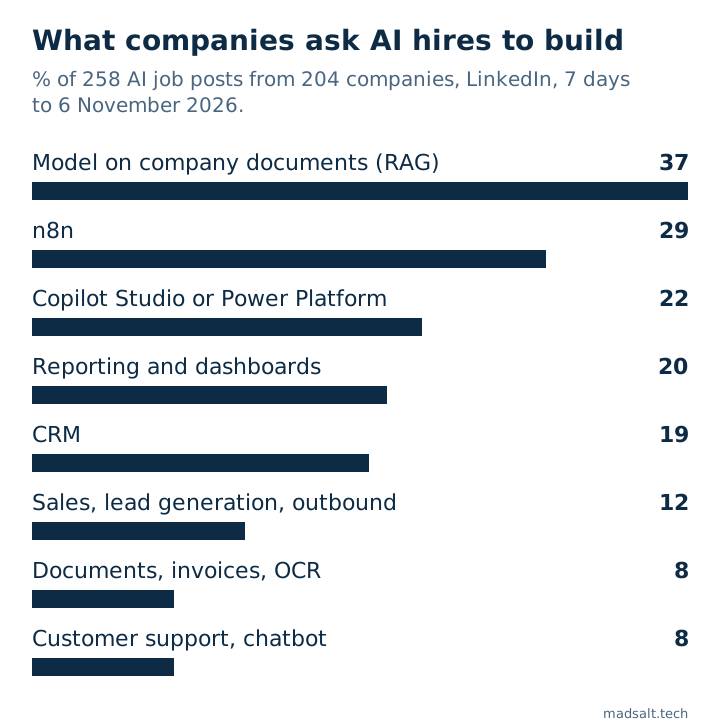
A post counts once per theme, and I matched the themes with a text search I did not check by hand, so read the shares as a rough picture. The pattern is clear: the typical job connects a model to the company’s own documents and tools, with a workflow builder in between, and explains the result to people who are not technical.
Which AI agent is best for a small business?
The best one is the one built for a single job you can check. There is no best product across jobs. Pick by these questions: does it run on your own documents, can you see which source it used, does it hand over when unsure, and what does it cost per month at your volume? The six jobs below are where I would look first.
Which jobs do agents do well?
Six that I would start with, in the order I would try them.
- Answer questions from your own documents. Staff or customers ask in plain language, and the agent answers from your manuals, contracts or price lists and shows which page it used. This is the biggest request in the job posts (37%). It works when the documents are current. It fails when two versions disagree.
- Read incoming documents. Invoices, forms and order emails become fields in your accounting or CRM, and unsure fields go to a person. 8% of the posts mention documents, invoices or OCR. I tested four models on invoices in invoice data extraction with AI.
- Sort and enter leads. A form or email arrives, the agent finds or creates the CRM record and scores the lead. CRM work appears in 19% of posts and sales or lead generation in 12%.
- Draft the weekly report. The agent pulls numbers from your systems and writes the first draft. Reporting and dashboards appear in 20% of posts. A person reads it before it is sent.
- Route internal requests. In a Microsoft 365 company, Power Automate and Copilot Studio can take a request from Teams or email, check it and send it to the right person. Power Platform appears in 22% of the posts. I work with these tools, including SharePoint and Graph.
- Answer customer messages. A first reply on WhatsApp, Telegram or the web chat, from your documents, with a handover when unsure. 8% of the posts mention customer support or chatbots. See AI receptionist for small business and what a WhatsApp AI chatbot costs.
What these have in common: a clear input, a clear output, a person who can tell when it is wrong, and a mistake that costs little. Start with the one where that is most true.
Can I get an AI agent for free, and what does a paid one cost to run?
Free tools exist for single chat tasks. An agent that runs your jobs every day has a monthly bill.
Three meters: the model calls, the systems the agent drives, and the work of keeping it healthy. The model calls are the easiest to calculate. The line is steps per task × tasks per month × the price of one step.
Here it is for a small workload, 20 tasks a day with 4 model calls each, 2,400 calls a month. One call is 4,000 tokens in and 500 out. These are API list prices of 15 October 2026 from my article how much an AI agent costs per month. Prices change fast, so check them again before you plan.
| Workload | DeepSeek V4.1 Flash | Claude Haiku 5.5 | Claude Sonnet 5.5 | Claude Opus 5.5 |
|---|---|---|---|---|
| Small: 20 tasks a day, 4 calls each | $1.09 | $1.56 | $31 | $62 |
| Medium: 200 tasks a day, 6 calls each | $16 | $23 | $468 | $936 |
The model you choose moves the bill about 140 times between the cheapest and the dearest in that article. A small model handles most sorting and field-pulling. Keep the large ones for hard reasoning.
On top of that:
- A server and the tools the agent drives. Some of those cost more than the model, for example browsers and proxies. In my measured example, one benchmark run used proxy traffic of about $3.08.
- Someone reading the alerts. The failures that cost most were silent ones, such as an outage that ran for 8 days with no alert. A first test on real data and an alert for anything that can go quiet is part of the price.
- A cap per run in code, not only a monthly limit on the account, so a loop cannot run the bill up.
Plan prices and tiers for my work stay on the pricing page.
Where do AI agents fail?
- They are wrong, and they sound sure. In the UK government’s 2026 survey of 3,503 businesses, 56% of firms already using AI said they were concerned about bias and lack of accuracy.
- Pilots do not reach production. The Gartner forecast is that over 40% of agentic AI projects will be cancelled by the end of 2027, because of cost, unclear value or weak risk controls. The MIT NANDA report says 95% of pilots show no measurable profit impact; its authors note the study is self-reported and limited.
- “Agent” is sometimes a renamed chatbot. Ask to see it run on your own example.
I would add one failure of my own: an agent that reports success when it did nothing. One of my scraping jobs once went through 359 dates in 12 minutes, saved 0 rows and said it succeeded. It now stops after 25 empty dates and says why. Every job needs a check that “done” produced something.
How much human review should you keep?
In that UK survey, 81% of businesses applied some human input or oversight to AI output, and agentic AI was trusted less than simple drafting tools. I agree with that order.
A rule I use:
- Low cost of a mistake, such as a draft or an internal summary: a person samples the output weekly.
- Medium, such as a record that feeds a report: the agent flags unsure items, a person checks those, and a sample of the rest.
- High, such as money, contracts or anything legal: a person approves each item. The agent prepares it.
An agent that cannot say “I am unsure” is not ready. Ask how it decides to hand over, and what happens to the item when it does.
How do you build an AI agent for a small business?
Pick one job from the list, count how many hours it takes a month today, and test on 20 to 30 real examples before building anything large. Write the pass mark first. If you are unsure whether your documents and systems are ready, run the AI readiness check first. If you need to hire someone for this, read hire an AI automation specialist.
For how I build them, see AI agent development, and if you are still choosing what to automate, AI consultant for small business.
My similar case
For a real-estate document service I built a system that turns a property certificate that took 2 to 3 weeks and cost EUR 200 to 300 into one that takes 2 to 3 minutes and costs EUR 99. A script handles the main known portal, where 95% of documents are completed. Vision AI reads only the portals the scripts do not know, behind a switch that turns it off at once. The agent is the smaller part on purpose. The build is in the property document automation case.
Want an agent with a bill you can predict? Write to me with the job and we’ll work out the best solution for you.
Tell me which job to start with
Describe the repeated task and who checks it today. I'll reply with what I would build first and what it should cost to run.
Write to meSources
- My count of AI job posts: 258 posts from 204 companies, LinkedIn, 7 days to 6 November 2026.
- Model call prices and the workload examples: my article how much an AI agent costs per month, list prices of 15 October 2026.
- UK Department for Science, Innovation and Technology, AI adoption survey report 2026: executive summary, 29 October 2026 (3,503 businesses; 56% accuracy concerns; 81% human oversight).
- Gartner, press release of 25 June 2025: a forecast, not a measurement.
- MIT NANDA, State of AI in Business 2025 (August 2025), as covered by Fortune, 18 August 2025.