TL;DR
Sellers’ own pages put a typical penetration test at $5,000 to $35,000, with $30,000 as the top of most ranges, and complex work can pass $100,000. One seller says anything listed below $4,000 is probably not a real test. For a small SaaS on Supabase or Lovable, a buyer’s questionnaire usually starts with whether one client can reach another’s data, and you can run that test yourself before you pay for anything. These are list ranges from seller pages, not a survey, and I did not collect quotes.
A buyer’s security questionnaire often has a line asking for a penetration test report, and the next search is what one costs. The answers online are written by people who sell the tests, so this article gives the numbers first, with the page each one comes from, and then what a test checks, when you need one and what to do before you pay.
How I got the numbers. On 6 November 2026 I read the cost pages of five sellers and took each range as written. I did not average them, and none of the sellers is mine. A list range is not a signed quote.
How much does a penetration test cost in 2026?
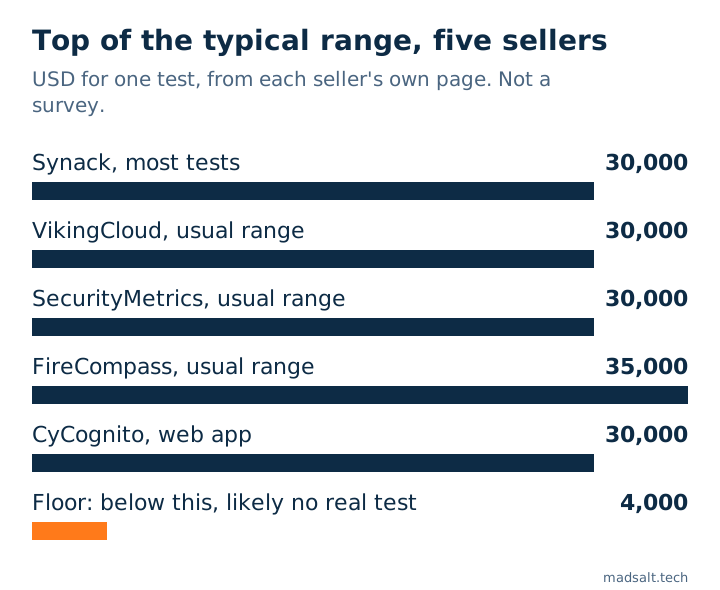
Most ranges end at $30,000 or $35,000, and most start between $5,000 and $15,000.
| Seller | What the page says | Page date |
|---|---|---|
| Synack | $5,000 to over $100,000, most tests $10,000 to $30,000, all-types average about $18,300 | 25 June 2026 |
| VikingCloud | $5,000 to $30,000, up to $60,000 or more | 10 November 2025 |
| SecurityMetrics | Usually $15,000 to $30,000 | not dated |
| FireCompass | Average $10,000 to $35,000 | 30 January 2025 |
| CyCognito | Web application $5,000 to $30,000+ | not dated |
By type of test, VikingCloud lists a web application at $5,000 to $30,000, an API at $5,000 to $20,000, cloud at $10,000 to $40,000 and a mobile app at $12,500 to $40,000. Synack, FireCompass and CyCognito give the same $5,000 to $30,000 for a web application. For a small SaaS, the web application and API lines are the ones that apply.
Why do quotes differ so much?
Four things move the number, and the page ranges hide all of them.
- Who does the testing. Hardened Review, checking each firm’s own page on 24 October 2026, lists starting prices for one web application: $3,500 to $4,181 for AI-led tests (Cobalt, Intruder, Synack) and from $4,999 for human-led ones. Synack’s researcher-led standard test starts at $10,283.
- How the scope is counted. FireCompass names scope, the testing method (black box with no inside knowledge, or white box with full access) and compliance documentation as drivers. In an app, the number of user roles and of API endpoints is the scope.
- What the price includes. SecurityMetrics says its quote includes retesting. Hardened Review notes that Synack’s platform is a separate line item on top of its test prices.
- How it is billed. VikingCloud lists hourly, fixed fee and subscription.
About the $4,000 floor: it is SecurityMetrics’ own view, and Hardened Review points out that AI-led tests now sell below it. The useful reading is not “cheaper is fake” but “ask what a person actually does for that price”.
What does a penetration test check, and what breaks first in a small SaaS?
A web application test follows lists such as the OWASP Top 10 and tries what an attacker would try, for example reaching another user’s account (CyCognito). On a small app built on Supabase or Lovable, the same few things tend to break first, and I have written each one up with a way to check it:
- Open tables. A scan of 1,645 Lovable showcase apps found 303 endpoints in 170 of them that served data to anyone holding the public key (CVE-2025-48757). The Lovable security checklist has the queries.
- One client reaching another. In my own test on a deliberately broken schema, the four read checks most people try came back clean while 6 of 14 requests at a second company leaked. The multi-tenant isolation test shows every path.
- Keys in the browser. A secret key skips every access rule, so one in the browser undoes the rest.
- Views, functions and storage. Each one can skip your row level security in its own way.
A pentester finds these by testing, and you pay for the days it takes. Most of the list can be checked in a few hours for free, and I would expect a tester to need less time on an app that has already passed it. That is my reasoning, not a quote from any of the sellers.
When do you actually need a penetration test?
When someone else asks for the report. That is usually an enterprise buyer’s security questionnaire, an auditor or a rule that applies to your data. SecurityMetrics’ page lists PCI, SOC, HIPAA and GDPR among the standards that call for one, and says elective tests exist for teams with no such duty. It also says a significant change to your environment means testing again. I did not verify what each framework or each buyer accepts, so ask them before you buy.
A vulnerability scan is a different, cheaper thing. SecurityMetrics describes it as fully automated and listing potential weaknesses, while a pentest tries to exploit them by hand.
What can you do before you pay for one?
- Run the free Supabase security check. It tests a project against 46 OWASP Top 10:2025 rules: policies that allow every row, views that skip RLS, exposed grants and auth settings.
- Run the two-account test from the isolation article: user A in company 1 attacks company 2 by every path, then you read the database to see what changed.
- Go through the Lovable checklist for views, functions, storage and rate limits.
- Keep the output: the list of paths, the result of each and the date. A buyer can read that, and it shortens whatever a tester has to cover.
- If you want an outside read first, a fixed-scope review of a vibe-coded app gives a written verdict on what to keep, fix or rewrite. Its own page says it is not a penetration test.
How do you compare two quotes?
Put the same questions to both:
- What is in scope: which roles, how many endpoints, which environments?
- Is the test led by a person or by AI, and who reviews the findings?
- Does the tester get accounts in two different companies, so tenant isolation is actually tried?
- Are retests included, and how many rounds?
- Are there separate platform or report fees?
- What do I receive, and will my buyer or auditor accept it?
Limits. Every figure is a seller’s own list range from a page I read on 6 November 2026. They are not signed prices, I did not request quotes, and I did not look for prices outside the US. The vulnerability counts come from my own small test and a public disclosure, so they show what a quick check can miss, not how common each mistake is. Nothing here replaces a penetration test when a buyer or a rule requires one.
My similar case
Building a time tracker for an audit firm, I found 4 errors no screen showed, including a confidential client leaking through report totals and tag counts. Every access rule now lives in the database and is tested before each deploy; the full story is in the audit firm case.
Got a quote and not sure what it covers? Write to me and we’ll work out what your app really needs tested.
Got a pentest quote?
Tell me what you have now and what you need. I'll reply with the option I'd pick.
Write to me