TL;DR
Since 1 October 2026, Meta charges for the bot’s replies too: the first 1,000 replies per phone number each month are free, then every reply costs the same as a utility message. For a business in Portugal that is USD 0.0171 (EUR 0.0142) per reply. A reply from a small AI model costs about USD 0.0002 in tokens, so on a cheap model Meta’s fee is roughly 85 times the AI bill. A bot that sends 3,000 replies a month to Portuguese numbers pays Meta about EUR 28.40.
I’m Denys, a full-stack and AI engineer. I built an interactive prototype of a WhatsApp and Telegram chatbot on sample chats: a visual flow builder, AI answers from the company’s own documents, lead scoring and a handoff to staff. Below is how such a bot is put together and what it costs to run, worked out from Meta’s rate card and the model vendors’ price pages, all read on 15 October 2026.
What does Meta charge for a WhatsApp chatbot?
Meta charges per message the business delivers, never for messages customers send. The price depends on the message type and on the country code of the customer’s phone number, not on where your business is.
- Service messages are the bot’s free-form replies inside the 24-hour window that opens when a customer writes. Since 1 October 2026 the first 1,000 per phone number each month are free; after that each one costs the utility rate.
- Utility templates are updates such as booking confirmations and reminders. Since 1 October 2026 they are charged even inside the 24-hour window.
- Marketing templates are promotions, offers and anything else that is not a transactional update. They are the expensive category and never get cheaper with volume.
- Free entry point: when a customer arrives through a Click-to-WhatsApp ad and you reply within 24 hours, messages in that conversation are free for up to 7 days.
Meta’s rate card effective 1 October 2026, per delivered message:
| Customer’s country | Marketing | Utility, authentication and service |
|---|---|---|
| Portugal (billed as “Rest of Western Europe”) | USD 0.0592 (EUR 0.049) | USD 0.0171 (EUR 0.0142) |
| Brazil | USD 0.0625 (BRL 0.3217) | USD 0.0068 (BRL 0.035) |
| Spain | USD 0.0707 | USD 0.0200 |
| Germany | USD 0.1365 | USD 0.0550 |
| United Kingdom | USD 0.0635 | USD 0.0220 |
| United States and Canada | USD 0.0250 | USD 0.0034 |
Meta changes these rates only on the first day of a quarter. Check the official pricing page before you plan, because several popular guides still describe the old rules, where replies inside the window were free.
How much does each AI reply cost?
The model is billed in tokens: the text you send in (instructions, document passages, recent messages) and the text it writes back. A useful working assumption is about 1,600 tokens in and 80 tokens out per reply; one chatbot vendor reports that average from its own logs. Your bot will differ, so measure it once it runs.
Every business picks a different model, so here is the same reply priced on several. Prices are OpenRouter’s list on 15 October 2026, which matches the vendors’ own price pages:
| Model | Price per million tokens, in / out | One reply (calculated) | 3,000 replies a month |
|---|---|---|---|
| DeepSeek V4.1 Flash | USD 0.024 / 0.72 | about USD 0.0001 | USD 0.29 |
| Claude Haiku 5.5, GPT-6 Luna | USD 0.10 / 0.50 | about USD 0.0002 | USD 0.60 |
| Qwen3.8 Flash | USD 0.15 / 0.47 | about USD 0.0003 | USD 0.83 |
| Mistral Small 4 | USD 0.15 / 0.60 | about USD 0.0003 | USD 0.86 |
| Gemini 3.5 Flash Lite | USD 0.30 / 2.50 | about USD 0.0007 | USD 2.04 |
| Gemini 3.8 Flash | USD 0.75 / 3.75 | about USD 0.0015 | USD 4.50 |
| Claude Sonnet 5.5, GPT-6.1 Sol | USD 2 / 10 | about USD 0.004 | USD 12 |
| Claude Opus 5.5 | USD 4 / 20 | about USD 0.008 | USD 24 |
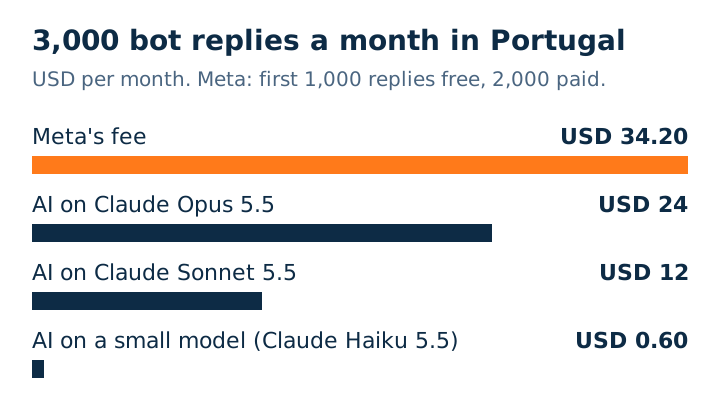
So the choice of model moves the AI bill about 80 times, from USD 0.29 to USD 24 for the same 3,000 replies. Even on Claude Opus 5.5 that is less than Meta’s USD 34.20 for those replies in Portugal; on a small model, Meta’s fee is the bigger line by far. A small model is often enough for answering questions from your own documents; send only the hard cases to a larger one.
What does one bot cost per month in different countries?
Take one bot on one phone number that sends 3,000 replies a month, all inside the 24-hour window, on a small model. These are calculations from the prices above, not an invoice:
| Customers in | Meta: 2,000 paid replies | AI: 3,000 replies on a small model | Total per month |
|---|---|---|---|
| Portugal | USD 34.20 (EUR 28.40) | about USD 0.60 | about USD 35 |
| Brazil | USD 13.60 (BRL 70) | about USD 0.60 | about USD 14 |
| Spain | USD 40.00 | about USD 0.60 | about USD 41 |
| Germany | USD 110.00 | about USD 0.60 | about USD 111 |
| United Kingdom | USD 44.00 | about USD 0.60 | about USD 45 |
| United States | USD 6.80 | about USD 0.60 | about USD 7 |
Add hosting for the webhook and the knowledge base, and any partner fee if you connect through a WhatsApp solution provider instead of Meta’s Cloud API directly. Meta itself charges no extra fee for using the platform directly; partners set their own markup.
The same bot sending 1,000 marketing messages a month would add USD 59.20 in Portugal and USD 136.50 in Germany. Promotions, not answers, are where WhatsApp gets expensive.
How is a WhatsApp AI chatbot built?
Five parts, in the order a message travels:
- The channel. WhatsApp messages arrive through Meta’s WhatsApp Business Platform as webhook calls to your server. The same bot can serve Telegram and a website chat widget; the prototype handles all three in one inbox.
- The flow. A visual flow builder decides how a conversation goes. The prototype has nine kinds of steps: start, message, question, AI response, condition, action, delay, handoff and end. Fixed steps handle the greeting, the qualifying questions and the handoff; the AI fills only the open parts.
- The knowledge base. The bot answers from documents the company uploads, not from whatever the model remembers. Every AI reply carries the source it used, so staff can check it.
- The handoff. When the bot is unsure, it hands the chat to a person instead of guessing. Below a confidence line, a human takes over in the shared inbox.
- The lead record. Each contact is marked cold, warm, hot or customer, gets a short summary, and hot leads go to the CRM.
Why should the bot answer only from your documents?
A model left to answer freely sounds sure even when it is wrong, and nobody can check where an answer came from. In the prototype I chose answers from uploaded documents, with a handoff below a confidence line. The cost of that choice: someone has to keep the documents current, or the bot will confidently repeat last year’s prices.
Who should control how a conversation goes?
The team, not the model. When the model leads every chat, conversations drift and a lead can leave without being asked the questions that matter: what they need, when, and how to reach them. A flow builder keeps those steps fixed and lets the AI handle what customers actually type in between. The cost: every flow needs an owner who updates it when the offer changes.
What can go wrong with the bill?
- No payment method on file. Without one, Meta still delivers the first 1,000 free replies each month, then stops delivering replies until you add one.
- Reminders sent as the wrong type. A message Meta treats as marketing costs about 3.5 times a utility message in Portugal and 9 times in Brazil. Keep reminders and confirmations strictly informational.
- Prompts that grow. Sending the whole chat history and every document with each reply multiplies the token bill quietly. Send the last few messages and the few passages that match the question.
- Old guides. Many pricing pages written before 1 October 2026 still say replies inside the window are free. For a bot that mostly answers, that is the line that changed.
When is a chatbot the wrong choice?
When most of your customers write once a month with a question only a person can answer, a shared inbox with saved replies may do the job for less. A bot pays off when the same questions arrive every day, at hours when nobody is there to answer.
What these numbers do not tell you
The monthly figures are calculations from list prices, not an invoice; the prototype runs on sample chats. Token counts depend on your prompts and documents, so measure them in your first week. Prices are in USD as Meta and the model vendors list them, before VAT, and they change: Meta’s on the first day of a quarter, the model vendors’ whenever they announce it.
If you are weighing a WhatsApp bot for your business, I am happy to compare notes. The WhatsApp chatbot case shows the prototype, and my AI agent development page shows how I work.
Sources
- Meta, WhatsApp Business Platform pricing and its rate cards effective 1 October 2026 (USD, EUR, BRL), read 15 October 2026.
- OpenRouter, model list prices; Anthropic, Claude pricing; OpenAI, API pricing; Google, Gemini API pricing. All read 15 October 2026.
- Average tokens per reply: ReplyKit, How much does a WhatsApp AI agent cost, 5 September 2026.