TL;DR
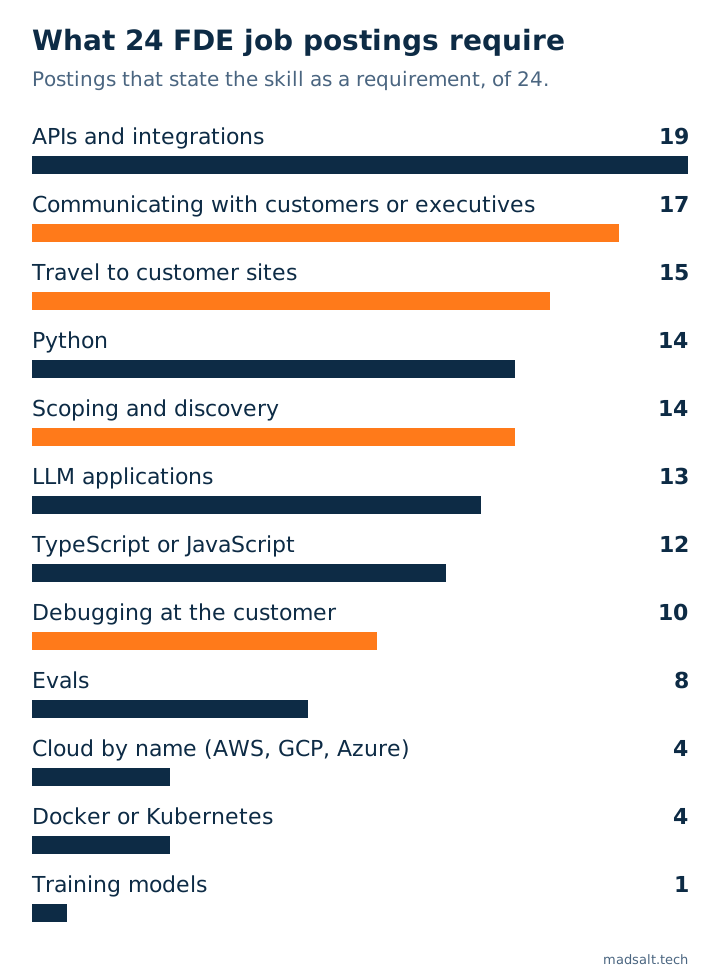
In 24 forward deployed engineer (FDE) postings from 2026 that I read and coded, the most required skill was not a language. 19 asked for API and integration work, 17 for talking to customers or executives, 15 for travel and 14 for scoping a problem before building it. Python (14) and TypeScript or JavaScript (12) were the only languages more than three postings required. Cloud, Kubernetes and Terraform were each required by 4 or fewer. LLM work was required in 13, evals in 8, model training in 1. 20 postings gave a minimum experience; the median was 4 years.
I’m Denys, a senior full-stack and AI engineer in Porto, and I work as a forward deployed engineer on a subscription. Most skill lists for this role come from course sellers and read like a syllabus. I wanted the list employers write, so I opened 24 FDE postings and marked what each one states as a requirement, separately from what it only calls a bonus.
What skills does a forward deployed engineer need?
On 28 October 2026 I re-opened the same 24 postings I had used for AI engineer vs forward deployed engineer: Cursor, Databricks, OpenAI’s deployment company, Anthropic, Salesforce, Palantir, Scale AI, PagerDuty and 16 other companies, all on their own career pages or Ashby, Greenhouse and Lever boards. A skill counts as required only when the posting puts it in the requirements or writes it as a duty.
| Skill | Required | Required or preferred |
|---|---|---|
| APIs and integrations with customer systems | 19 | 19 |
| Communicating with customers or executives | 17 | 18 |
| Travel to customer sites | 15 | 15 |
| Python | 14 | 17 |
| Scoping and discovery | 14 | 14 |
| LLM applications (prompting, RAG, tools, agents) | 13 | 14 |
| TypeScript or JavaScript | 12 | 14 |
| Debugging in production or at the customer | 10 | 10 |
| Frontend or full-stack | 8 | 8 |
| Evals | 8 | 8 |
| Data pipelines | 7 | 10 |
| ERP or CRM integration | 6 | 6 |
| Cloud by name (AWS, GCP, Azure) | 4 | 5 |
| Docker or Kubernetes | 4 | 4 |
| Terraform or other infrastructure as code | 3 | 3 |
| Degree in CS or similar | 2 | 4 |
| Training or fine-tuning models | 1 | 1 |
The top of the list is connecting things and talking to people. Afresh’s posting says it plainly: “About a quarter of the job is time with them, and that time decides what you build.” Salesforce asks for the “ability to whiteboard architecture with enterprise CTOs and VPs while writing production code alongside lead architects.”
Which programming languages do FDE postings ask for?
Python and TypeScript, and then a long tail. 18 of the 24 postings required at least one language. Python was required in 14, TypeScript or JavaScript in 12. Go, Java or Kotlin, and C++ or Rust were each required in 3.
Six postings required no language at all. Two of them (Aircall and Code Metal) listed languages only as a bonus, and Aircall’s says “this is not a software engineering role”. The other four described the work and left the language open.
If you are choosing one language to be strong in for this role, the postings point to Python, with TypeScript as the second one for the frontend and integration glue.
Do you need cloud, Kubernetes or Terraform?
Rarely as a stated requirement. Named cloud providers were required in 4 postings, containers in 4, Terraform or similar in 3. Compare that with APIs in 19.
One caveat changes these numbers a little. Several companies list their own stack (for example Lovable: Go, Rust, React, Cloudflare, GCP, AWS, Terraform) without asking the candidate for it. I did not count stack lists as requirements. If you count them, cloud goes from 4 to 6 and Terraform from 3 to 5. Either way, infrastructure is a much smaller part of the job than integration.
How much AI do you need to know?
Building with LLMs, yes; training models, almost never. 13 of 24 postings required LLM application work: prompting, retrieval, tool use or agents. 8 required evals, meaning a way to measure whether an agent does its job. Dialpad wants you to “develop evaluation methods, guardrails, and acceptance criteria that measure agent usefulness, reliability, safety, task success, and production readiness.”
Only Palantir’s posting asked for model training, as part of “Machine Learning basics”. The 11 postings that did not require LLM work were deployment, integration and data roles: at defence, industrial and data-platform companies, and also at OpenAI’s deployment company, Lovable and Intercom. The title says where you work, not whether you build AI. I compared this with AI engineer postings in AI engineer vs forward deployed engineer.
Which non-coding skills matter?
Three show up next to the language lists in almost every posting:
- Communication. 17 postings required explaining, presenting or briefing. I counted only explicit wording. If “works directly with customers” also counts, it is 23 of 24. Cursor: “You can talk to working engineers and to a VP.”
- Scoping. 14 required turning a vague customer problem into something buildable, before writing code. Scale AI’s version: “Translate ambiguous customer problems.”
- Debugging in someone else’s environment. 10 required troubleshooting in production or at the customer site. Aslan: “This is an engineering role, not a deployment or support role. You write production code at customer sites.”
Travel was required in 15. Where a share was given, it ranged from 10% to 75% of the time. On my own projects scoping is the part that decides the outcome: what a forward deployed engineer does differently is sit with the workflow before agreeing what to build.
How do you become a forward deployed engineer?
The postings say who they hire from. Counting each background that a posting asks for or welcomes:
| Background the posting names | Postings |
|---|---|
| Production software engineering | 15 |
| Solutions engineer, architect or implementation | 8 |
| Consulting or professional services | 7 |
| A previous forward deployed or field role | 7 |
| Former founder or founding engineer | 5 |
| Data engineering, data science or ML engineering | 4 |
| Defence, military or intelligence | 4 |
| Security clearance | 3 |
| Degree required | 2 |
20 postings stated a minimum experience: the median was 4 years, the range 0 to 9, and 8 asked for 5 years or more. No posting said a degree is unnecessary, but 20 of 24 did not mention a degree at all. PagerDuty: “Former founders and founding engineers tend to do well in this role.”
Read together, the counts suggest a route. This is my reading, not something the postings state:
- Be a production engineer first. Python or TypeScript, real APIs, real integrations, code that someone else depends on. 15 postings name software engineering as the base, and the median asks for 4 years of it.
- Get customer time. A solutions engineer, consulting or implementation role, or a support rotation where you fix things in front of the customer. 11 postings name one of those backgrounds or a previous field role.
- Ship one LLM feature with an eval. Not a demo: a feature with a test that says whether it works. That covers the 13 and the 8 above.
- Practise scoping in writing. Before building, write down the problem, what “done” means and what you will not build. That is what 14 postings mean by discovery.
If you are on the other side and need this work done without a hiring round, the options are compared in FDE vs agency vs freelancer. How long hiring takes is in hiring a forward deployed engineer takes months.
Is every FDE posting the same job?
No. Aircall’s FDE posting says it is not a software engineering role. Onebrief’s requires an active Secret clearance and travel up to half the time. Afresh and Form Energy hire at Staff level with 4 and 8 years minimum. A posting titled FDE can mean an engineer at the customer, a solutions engineer or a deployment specialist. Read the requirements, not the title.
How I counted
- The 24 postings were found with searches on 24 October 2026 and re-opened in full on 28 October 2026. All 24 were still online.
- Required means the skill is in the requirements or written as a duty. Preferred means “nice to have”, “bonus” or “ideally”.
- A language in an “X, Y or Z” list counts for each language named. Communication counts only when the posting asks for explaining, presenting or briefing.
- One reader coded every posting in one pass, with no second check.
Limits. 24 postings is a small convenience sample: one posting moves a percentage by about 4 points. US companies and venture-backed AI startups are overrepresented, and 12 of the 24 come from one job board (Ashby). Seven postings showed no publish date. The sample mixes engineering, solutions and hardware deployment roles. Read every number as “in these 24 postings”, not as the market.